I have long been captivated by the intensity of Dido's love for Aeneas, so to see the geographic setting of this portion of Virgil's Aeneid was a joy in itself.
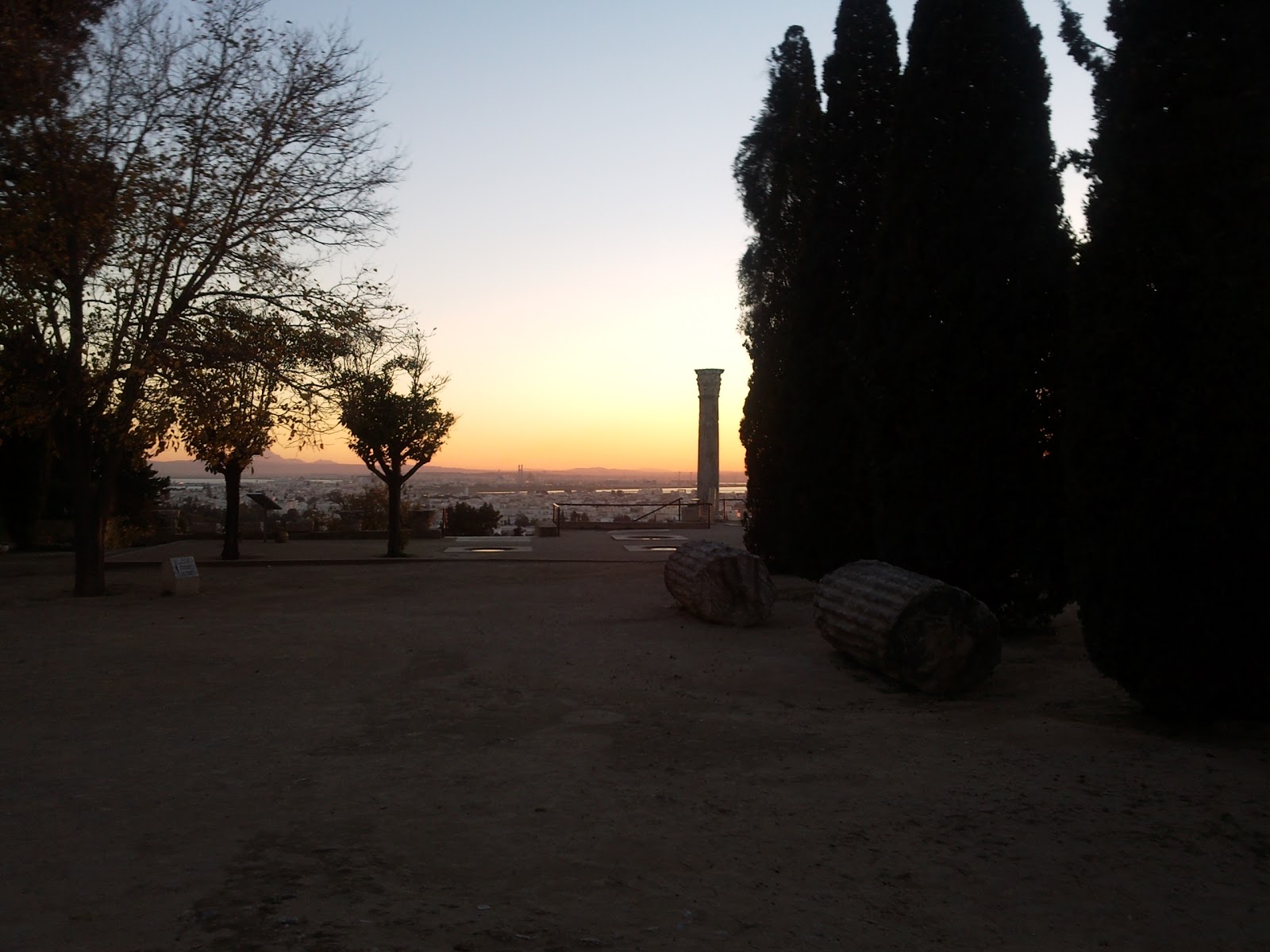
Sunset. Ancient site of Carthage on the sea.
A tavern in Sidi Bou Said. Have some tea, smoke a waterpipe, converse with the friendly locals.
December 17, 2010. I arrive
at Tunis International Airport, setting my feet on the ground, and smiling at
the sunshine and the almost 60-degree-Fahrenheit weather. My first time on the
African Continent, my first time in the Maghreb, my first time in the “Arab
World.”
About a half-hour earlier (it only takes an hour and fifteen minutes to
travel from Rome to Tunis), I am eating, to be honest, the best airplane food I have ever had,
on TUNISAIR. A huge tray of Mediterranean cuisine, sweet and savory.
I notice that the flight
hostesses are, how should I say, quite voluptuous and tall compared to the lines one is used to
seeing in Italy. They appear to be in style, as is the President’s wife, Leila
Ben Ali, who fills magazine pages of some of the only reading material available
onboard. “President’s wife Instructs Women on Independence, Entrepreneurialism,”
etc., and “President’s Wife on Civil Liberties and Democracy.” Hmm, I think. It
would seem so. No mention of freedom of
the press, of course.
Two hours earlier, I am
sitting in traffic, a cold, grey day, with talk of snow. Judging by the street
I am on to get to Leonardo Da Vinci airport in Fiumicino and the
painfully-sharp sound of sirens, it could almost be New York.
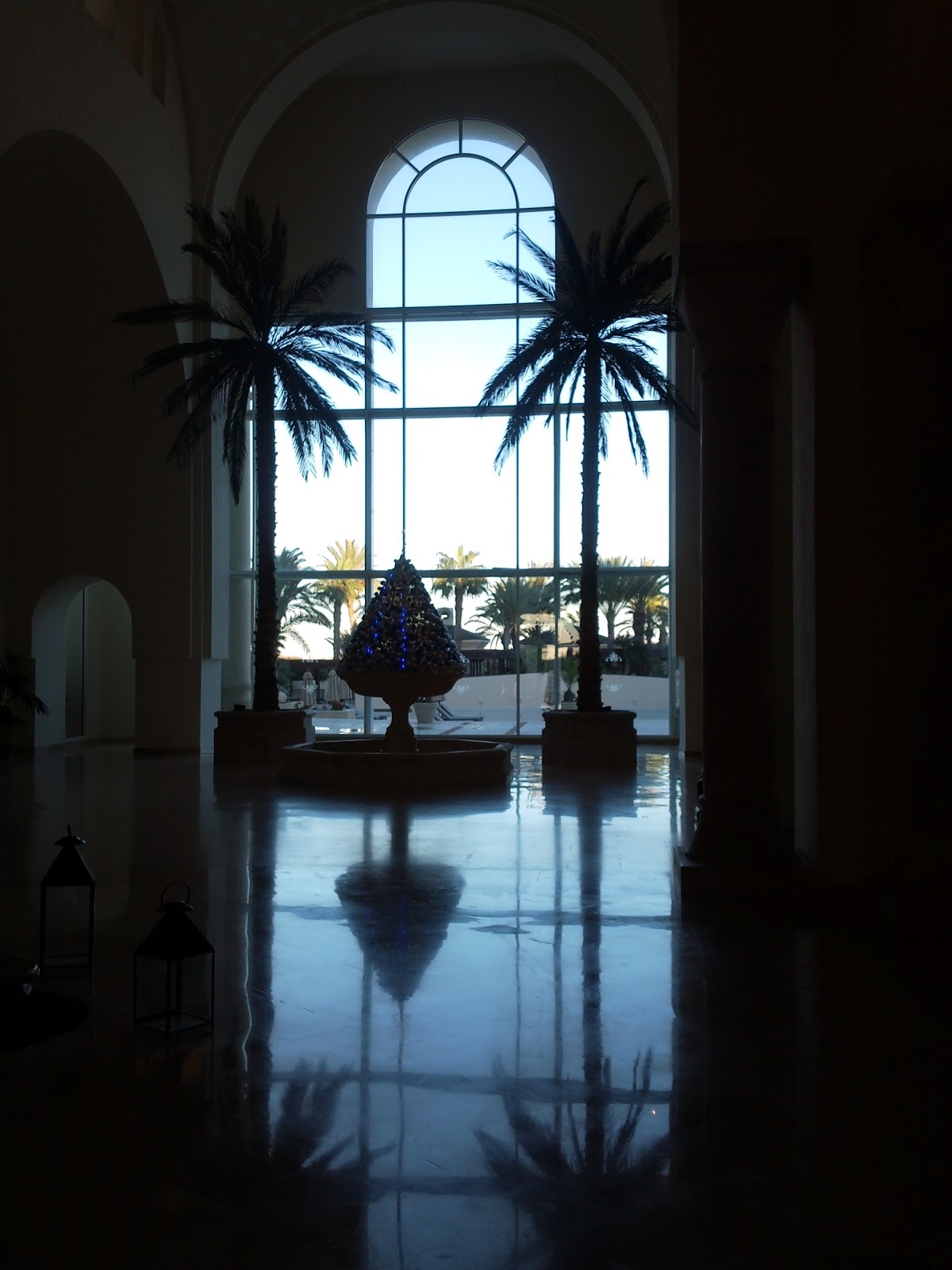
The palatial lobby inside Carthage's The Residence Hotel. The gorgeous scent of orange blossom floating through the halls is enough to put one in a state of bliss.
The timing of it all is quite
funny. The night before, I had been scanning the headlines of the world’s
newspapers online. The first of the shocking WikiLeaks had been released just a
few days before. The first ones I noticed regarding the fallout from the
American Embassy in Tunisia – published by Spain’s El Pais - had surprised me just a little bit.
The summary? The
governing family practices crony politics, holding onto the country’s riches
and stifling efforts by U.S. diplomats to hold seminars on free speech,
concerts to unite the American and Tunisian cultures, to spread democracy, etc.
In the car, I tell my travel companion what I read.
“Ma no, scherzi?” he says in Italian. “Are you joking? Tunisia is
like the Switzerland of the Maghreb. The Tunisians are in good shape, they have
the best economy in the Arab world, the closest thing the Middle East has to a
democracy, and the Tunisian women have the most rights compared to…” Basically,
the Tunisians have no reason to complain. I had my doubts, and in fact,
what he said would only be partly true.
Tunisia would turn out to be
gorgeous - and its people, seriously kind, open, and down to earth - but not without its share of intrigue.
Evergreen meets palms. In December, a tiny metallic Christmas tree greets guests at The Residence, accompanied by two narrow date palms.
After touching down, we make
our way by car to The Residence, passing through a rather suburban neighborhood
of homes in a style I have not quite seen before. Yes, Tunisia is where part of
the very first Star Wars film was made, so here a portion of the architecture resemble the structures –
though much more gentrified and in near-perfect harmony with the terrain – that
audiences will remember from Tatooine (an actual Tunisian city), for example.
The Residence is a luxurious
4 or 5 star resort sitting on the sea and on the edges of Carthage; it holds a Darphin spa inside, complete
with pool in an uber-large atrium, thalassotherapy and other treatments. Yet, that interested me much less
than another aspect here: the utter satisfaction of the not-too-faint,
not-too-overpowering perfume of Orange Blossom that graced my olfactory senses and relaxed
me as I walked throughout the entire ground floor of the hotel.
THIS is heaven,
I thought. THIS is the quintessential perfume of the southern Mediterranean, of the Maghreb, of
the Middle East. I mentioned it before – I have never been to this part of the
world, but that odor, for some reason, was exactly what I expected; it
triggered memories of the feelings and sensations I held of a place I had never
visited but that I had long felt and associated with it.
A French-influenced dessert at Carthage's The Residence.
At lunch, I ate dishes I had never before encountered,
all equally delicious and mostly fish-based. My main course consisted of a typical Tunisia dish, the brik, egg (or in my case, fish) deep-fried in pastry similar to phyllo dough; its shape is akin to the samosa, but larger and flatter. I was encouraged to eat dessert (that
is, I was reprimanded for initially having decided not to do so). Tunisia was
once under French control, so its desserts still fall under the colonizers’
influence, and incorporate those of my favorite Mediterranean and Middle
Eastern ingredients that are also native to the blessed Tunisian soil – especially
almond, rosewater, and pistachio.
This time, however, I chose three delicate
Madeleines with an elegant scoop of apricot sorbet. Supreme. Divine. Superb.
Then I asked for the noir, but was
urged to take the vert. I dutifully
changed my order and after the first sip, I understood why. Perhaps it is an
exaggeration, but if I could, I would spend part of every year in this place
just for its mind-bogglingly perfect mint green tea.
If I could, I would spend a good part of my year in this place strictly for its mind-bogglingly perfect mint green tea.
Read more below...